When doctors call something “rare,” it often reflects how the medical system is set up more than a pure count of how many people actually have it.
The core teaching: “Horses, not zebras”
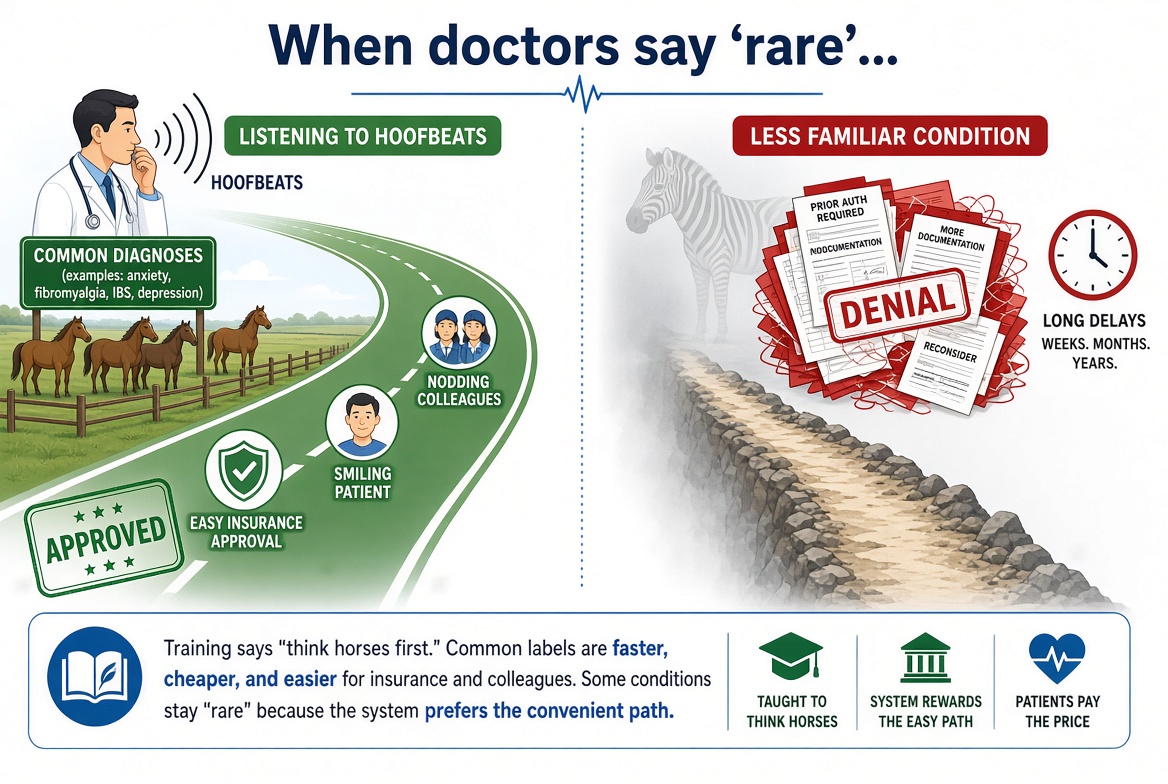
Doctors are trained with a practical rule: when you hear hoofbeats, think of horses first, not zebras. Common conditions (the “horses”) explain most symptoms most of the time. Starting there is efficient, protects patients from unnecessary tests and costs, and matches everyday clinical reality. A rare or less-familiar condition (the “zebra”) is “RARELY” considered later, if the common explanations don’t fit or treatment fails.
This works well for the majority of patients. The downside is that conditions that look similar to common ones, or that doctors see less often, get pushed aside or never seriously considered. Over time, those conditions stay labeled “rare” partly because fewer people receive that diagnosis.
Convenience and system pressures shape the Diagnosis
Several everyday factors make a common, popular diagnosis the path of least resistance:
- Time and training. Appointments are short. Medical education and guidelines emphasize high-volume conditions. A doctor who has seen hundreds of cases of anxiety, depression, IBS, fibromyalgia, migraine, or “stress-related” symptoms will reach for those labels quickly. Something less familiar requires more time, specialist knowledge, or tests that may not be immediately available.
- Acceptance by patients, colleagues, and insurers. A diagnosis that is widely recognized is easier to explain, document, and get covered. Common ICD codes sail through billing systems. A less common or emerging diagnosis may trigger denials, prior authorizations, appeals, or skepticism from other clinicians. It is simply smoother for everyone involved to stick with the familiar, reimbursable label.
- Patterns of care. Once a common diagnosis is assigned, treatment often follows a standard pathway. If symptoms persist, the next step is frequently more of the same or a related common label rather than reopening the differential diagnosis to less common possibilities.
As a result, some conditions that are not truly ultra-rare (or not primarily genetic) can still be treated as rare. They may be under-recognized, under-tested for, or routinely absorbed into popular catch-all diagnoses that the system already accepts.
What the evidence shows
Patients with conditions later identified as uncommon or monogenic frequently spend years carrying common diagnoses first. Diagnostic delays for rarer conditions commonly stretch to several years. The system’s preference for the statistically likely and administratively easy contributes to that lag.
In short: “Rare” is not always a pure biological fact. It can also be a practical outcome of training that prioritizes common patterns, limited time, and a payment-and-acceptance system that runs more smoothly on popular diagnoses. The common label is often the convenient, low-friction choice—even when a less familiar explanation may fit the person better.