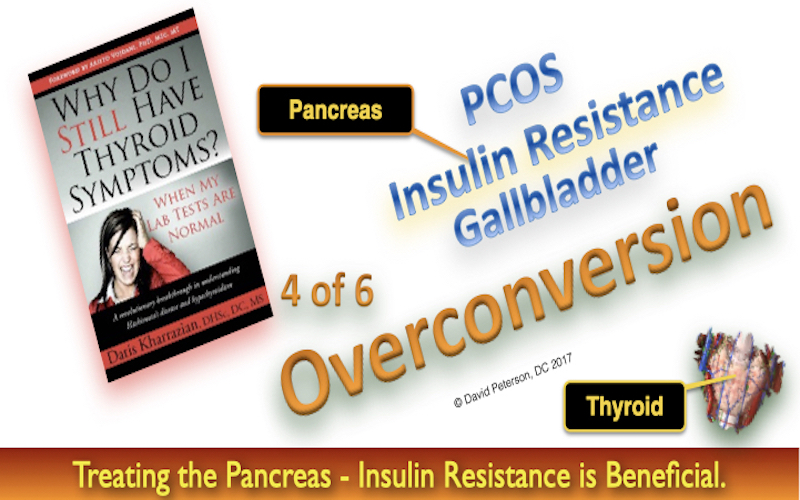
Thyroid over-conversion (also called thyroid overconversion) is one of the patterns of low thyroid function that Dr. Datis Kharrazian describes in his book Why Do I Still Have Thyroid Symptoms? When My Lab Tests Are Normal?
Simple explanation
Your thyroid mostly makes an inactive hormone called T4. Your body must convert that T4 into the active hormone T3 (using an enzyme called 5’-deiodinase) so it can turn on metabolism, energy, mood, and other functions in your cells.
In thyroid over-conversion, your body converts too much T4 into T3. This produces higher-than-normal (or high-normal) levels of active T3.
At first glance that sounds helpful, but chronically high T3 “floods” the cells. The cells respond by becoming less sensitive to thyroid hormone (a form of thyroid resistance). As a result, you develop classic low-thyroid symptoms—fatigue, weight gain, brain fog, cold intolerance, depression, etc.—even though blood tests may show normal TSH and plenty of (or excess) T3.
Typical lab pattern (according to Kharrazian)
- TSH: normal
- T4 (total and free): normal, low-normal, or low
- Free T3: high or high-normal
- Reverse T3: normal
- Thyroid antibodies: usually negative
What commonly causes it
The main driver Kharrazian highlights is elevated androgens (especially testosterone) that speed up the conversion enzyme. In women this is often triggered by:
- Insulin resistance / blood-sugar imbalance
- Polycystic ovary syndrome (PCOS)
(High insulin can push the ovaries to make more testosterone, which then accelerates T4-to-T3 conversion.)
It can also appear in people using exogenous testosterone or in some cases of insulin resistance even without full PCOS.
Bottom line in plain language
Too much active thyroid hormone (T3) ends up working against you. The cells get overwhelmed and stop responding properly, so you feel hypothyroid even when labs look “okay” or show high T3. Treating the underlying insulin resistance and androgen excess (rather than simply adding more thyroid hormone) is the key approach Kharrazian emphasizes for this pattern.
This is a functional pattern distinct from true primary hypothyroidism or under-conversion (where T3 is low). As always, interpretation and management should be done with a knowledgeable practitioner who looks at the full clinical picture.
Thyroid Hormone Overconversion Support Products
Related Keywords:
- Thyroid health
- Hypothyroidism symptoms
- Hashimoto’s thyroiditis treatment
- Non-thyroid conditions mimicking hypothyroidism
- Thyroid function tests
- Thyroid hormone replacement therapy
Top Competitor Sites with URLs:
- EndocrineWeb – https://www.endocrineweb.com/
- American Thyroid Association – https://www.thyroid.org/
- Mayo Clinic – https://www.mayoclinic.org/diseases-conditions/hypothyroidism/
Suggested Sites for Outreach and Backlinks:
- National Institute of Diabetes and Digestive and Kidney Diseases (NIDDK) – https://www.niddk.nih.gov/
- American Association of Clinical Endocrinologists (AACE) – https://www.aace.com/
- Thyroid Foundation of Canada – https://thyroid.ca/