
Pancreatic pseudocysts are the most common cystic lesions of the pancreas and may complicate acute pancreatitis, chronic pancreatitis, or pancreatic trauma. While the majority of acute pseudocysts resolve spontaneously, few may require drainage. On the other hand, pancreatic cystic tumors, which usually require extirpation, may disguise as pseudocysts.1Rabie ME, El Hakeem I, Al Skaini MS, El Hadad A, Jamil S, Shah MT, Obaid M. Pancreatic pseudocyst or a cystic tumor of the pancreas? Chin J Cancer. 2014 Feb;33(2):87-95.
The main difference is that a pancreatic cyst is a true cyst lined with its own tissue, while a pancreatic pseudocyst is a collection of fluid surrounded by scar tissue that forms as a complication of pancreatitis or injury. True cysts have an epithelial lining, whereas pseudocysts do not; they are a result of inflammation and do not typically involve cancerous cells, though they can cause problems if they grow large.2Whang EE. Acute pancreatitis. In: Mulholland MW, Lillemoe KD, Doherty GM, et al., editors. Greenfield’s surgery: scientific principles and practice. 4th Edition. New York, USA: Lippincott Williams & Wilkins; 2006. pp. 440–448.
The inadvertent drainage of a pancreatic cystic tumor, misdiagnosed as a pseudocyst, has obvious deleterious consequences, as tumor dissemination is inevitable if it was a malignant one. It is therefore mandatory to ascertain the nature of the cyst in question before embarking on treatment.
Pancreatic cyst
- Lining: A true cyst has an epithelial (cellular) lining.
- Cause: Can be caused by genetic disorders, or can be a retention cyst, neoplastic cyst (which can be cancerous), or parasitic cyst.
- Cancerous potential: Some true cysts can be benign, while others may be precancerous or cancerous.
Pancreatic pseudocyst
- Lining: Has no epithelial lining. Instead, the collection of pancreatic fluid is enclosed by a wall of fibrous or granulation tissue, similar to the tissue that forms over a wound.
- Cause: Always related to acute or chronic pancreatitis or trauma to the abdomen.
- Cancerous potential: Not precancerous and generally does not become cancerous.
- Resolution: Often goes away on its own, especially if caused by acute pancreatitis.
Key takeaways
| FEATURE | PANCREATIC CYST | PANCREATIC PSEUDOCYST |
| LINING | Epithelial lining | |
| CAUSE | Pancreatic Autodigestion, Infection, Alcoholism, Gallbladder or Pancreas Stone lodged in duct, Always a complication of pancreatitis or injury | Pancreatic Autodigestion, Infection, Alcoholism, Gallbladder or Pancreas Stone lodged in duct, Always a complication of pancreatitis or injury |
| CANCEROUS POTENTIAL | Can be benign, precancerous, or cancerous | Not precancerous, or biopsy negative |
What are the symptoms of a pancreatic pseudocyst?
Smaller pseudocysts may not cause any symptoms, but larger ones may be noticeable. They may cause symptoms similar to pancreatitis itself. But they usually develop several weeks after the onset of acute pancreatitis, or after a “flare-up” of chronic pancreatitis that disrupted your pancreatic duct.
Symptoms might include:
- Abdominal pain.
- Abdominal swelling.
- Loss of appetite.
- Nausea or vomiting.
Symptoms of complications, if they occur, might include:
- Fever or chills.
- Rising heart rate.
- Dizziness or lightheadedness.
- Jaundice.
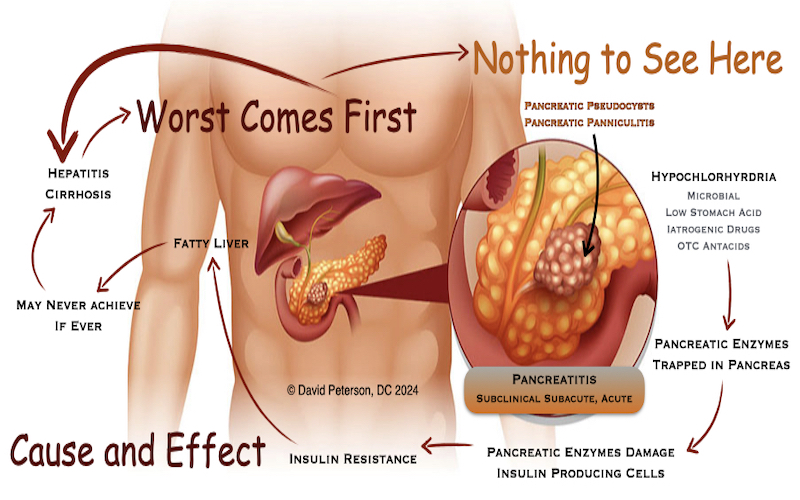
Doctors Do Not Recognize Chronic Pancreatitis
Doctors usually don’t realize someone has chronic pancreatitis until the pancreas has already lost most of its ability to work — often 80–95 % of the organ is scarred or destroyed.Why does it take so much damage before anyone notices?
- The pancreas has a huge “reserve capacity.”
It’s like having a 10-lane highway: even if 7 or 8 lanes are closed for construction, traffic (digestion and blood-sugar control) still moves okay for a long time. You only notice a major problem when almost all the lanes are gone. - Early symptoms are vague and common.
Belly pain after eating, bloating, loose stools, or losing a little weight — most people (and many doctors) blame these on stress, IBS, diet, or “getting older,” not on the pancreas slowly destroying itself. - The standard blood tests miss early chronic pancreatitis.
The usual amylase and lipase tests only go up when there is acute inflammation (a sudden attack). In chronic pancreatitis, those tests are often completely normal, even while the pancreas is quietly scarring year after year. - The real damage is inside the organ, not in the blood.
Chronic pancreatitis is the pancreas digesting itself over many years (autodigestion). The scar tissue slowly replaces the working tissue. Until that scar tissue is massive, blood tests, ultrasounds, and even CT scans can look totally normal. - By the time unmistakable signs appear, it’s very late.
When patients finally get the classic signs doctors recognize — severe weight loss, greasy stools that float (steatorrhea), and diabetes — it almost always means more than 90 % of the pancreas is already gone forever.
In short: the pancreas is a quiet, over-built organ that hides its damage extremely well. Doctors aren’t ignoring it on purpose; the disease is designed by nature to stay hidden until the destruction is nearly complete. That’s why many people only get diagnosed when it’s too late to save much of the pancreas.
Don’t wait for 90–95 % of your pancreas to be destroyed.
Catch hidden pancreas damage early with the BioScreen Sustain Max – the most comprehensive pancreatic function panel available.
🛡Direct markers of pancreatic insufficiency
🛡Analyze the Pancreas, Pancreas Head, Pancreas Body, Pancreas Tail, Spleen
🛡 Detects dysfunction years before diabetes or severe pain begins
Order your BioScreen Sustain Max Consultation + Lab Test today and know the true health of your pancreas — while there’s still time to protect it.
Click here to book your consultation and test kit now
(Results reviewed with a pancreas-specialized clinician Dr. Dave)

Bio Hacking Bio-Screen Sustain Max Lab Test
Brand: LabCorp, Principal Labs, HyrSelf
- 🔬Bio-Screen Sustain Max offer? $205.76 Value
- 📊 Functional Organ Systems Report: $300 Value
- 🩺 Blood Test Analysis:** $150 Value
References
- 1Rabie ME, El Hakeem I, Al Skaini MS, El Hadad A, Jamil S, Shah MT, Obaid M. Pancreatic pseudocyst or a cystic tumor of the pancreas? Chin J Cancer. 2014 Feb;33(2):87-95. ↩︎
- 2Whang EE. Acute pancreatitis. In: Mulholland MW, Lillemoe KD, Doherty GM, et al., editors. Greenfield’s surgery: scientific principles and practice. 4th Edition. New York, USA: Lippincott Williams & Wilkins; 2006. pp. 440–448. ↩︎